Amerindian leaders ask board to revoke uranium exploration permit in Region 7
Amerindian and civil society appellants asked Guyana's Environmental Assessment Board to revoke an exploration permit granted to Lia Guyana Inc and to require a full environmental and social impact assessment before uranium prospecting goes ahead at Kurupung, in Region 7.
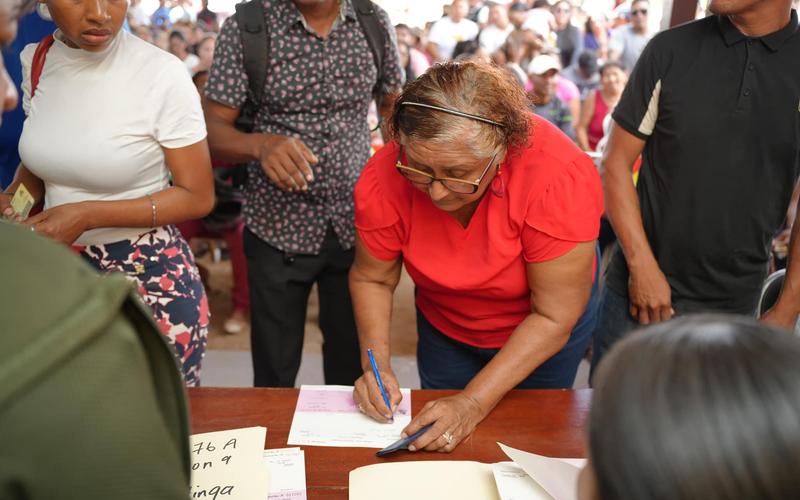
 Foto: Demerara Waves
Amerindian representatives and civil society activists have asked Guyana's Environmental Assessment Board (EAB) to revoke an exploration permit granted to Lia Guyana Inc, a local subsidiary of Canadian firm U92 Energy Corporation, and to require a full environmental and social impact assessment before uranium prospecting begins at Kurupung, in Region 7 (Cuyuni-Mazaruni).
The board heard three appeals, filed by the Greenheart Movement, Danuta Radzik and the Isseneru Village Group, at Cara Lodge in Georgetown. The appellants argued that the Environmental Protection Agency should not have waived the assessment before allowing the company to drill 55 to 65 holes as part of a 5,000 metre campaign over the next three years.
Why the communities object
Laura George, of the Greenheart Movement, said the assessment should have come before the company's environmental management plan, and that Indigenous peoples should be part of the whole process. She said the area near the concession matters for Indigenous culture, hunting and fishing, and that the wider area has already been polluted by mercury from gold mining. The communities represented at the hearing were Philippi, Jawalla, Kamarang, Waramadong and Isseneru.
Toshao of the Isseneru Village Council, Ivor Courtman, said the project area overlaps fishing grounds and sits close to farmland, and raised concerns about downstream pollution, water use, noise and the impact on sites the community considers sensitive.
Ms Radzik said the management plan was not published on the agency's website or shared with Indigenous communities, so it could not be scrutinised. Jamaican human rights lawyer Malene Alleyne argued that the agency had not met its statutory duty to publish adequate reasons for the waiver.
What the regulator and the company say
The EPA said it exempted the project in August based on the history of the location, current land use, the nature of the proposed work and the mitigation measures provided, and cited the International Atomic Energy Agency's position that a full impact assessment is not required at the exploration stage. Senior Environmental Officer Avanelle Jackson said the expected uranium grade is about 0.07% and that the work involves early-stage testing rather than processing or leaching.
She listed safeguards including restricted site access, protective equipment and quarterly radiation badges for workers, wet cutting of rock samples inside a ventilated building with continuous air monitoring, off-site shipments capped at five kilograms and sealed for transport, lined sumps for drilling wastewater, recycling of 75% to 80% of drilling water and sealing of empty boreholes with bentonite clay.
U92 Energy Corp chief executive and executive chairman Adam Clode said the management plan was built around Guyanese environmental and radiation safety law and international standards, and that the company is comfortable doing whatever the regulator asks of it. He said more than 58,000 background radiation readings had been taken on the property, and that 99.4% of them are below the United Nations level for normal background radiation.
Former Toshao of Kako and Amerindian People's Association vice president Mario Hastings urged caution, saying the rivers that run from Mount Roraima down to Bartica carry any impact far beyond the project site.